Samsung's new portable media players

Friday, January 7, 2011

0 comments

Samsung U6

The tiniest new Samsung MP3 player is the Samsung U6, available in hot pink and black. It is likely intended for runners and other consumers who don't need a lot of music at all times and would prefer to have something more petite.
The display, however, is so hard to read that there might as well not even be one. A click wheel (or square in this case) like the current iPod shuffle would be simpler and less distracting, not to mention easier to navigate.


Samsung Q3

The second smallest of the new releases is the Samsung Q3, available in white with a hot pink trim or black with a silver aluminum outline. Reminiscent of an older iPod nano mixed with a Zune, the Q3 sports a 2.2-inch TFT LCD (320 x 240 resolution) and holds either 4 or 8GB of content. This one didn't stand out on the table much, but it was definitely easier to operate than the U6.

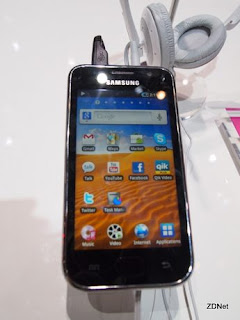
 Samsung Galaxy Player

Samsung Galaxy Player would be like the iPod touch version of the Galaxy S smartphone series. The Android 2.2-powered device is a nice gadget with a beautiful 4-inch WVGA SuperClear LCD panel. But don't expect anything new here except the lack of phone service.
No word on when this one will hit U.S. shores, if ever.

Samsung reveals 4G LTE smartphone

0 comments

LAS VEGAS — Verizon and Samsung together on Thursday announced the latter company’s first 4G LTE-enabled smartphone, which runs on Google Android 2.2.
The handset — which appears to be unnamed, oddly, unless it’s actually called “4G LTE” — distinguishes itself with an AMOLED Plus display, a 1GHz processor and rear and front-facing cameras.
Here’s what we do know:
  • Android 2.2 operating system
  • 4.3-inch Super AMOLED Plus touchscreen display
  • 1GHz application processor
  • HTML 5 web browser
  • 4G LTE connectivity
  • Rear-facing 8 megapixel camera with LED flash
  • Front-facing 1.3 megapixel camera
  • Supports video chat
  • Swype for virtual QWERTY keyboard
  • Preloaded with LTE-specific applications
  • Access to Samsung’s Media Hub content service and Social Hub platform
Stay tuned.

LG, Sharp debut LED HDTVs that live large in the "70s"

0 comments
If you thought 65 inches was about as big as an LCD HDTV could get (without costing tens of thousands of dollars), then LG and Sharp will dispel that notion with their new sets that break the “60s” barrier.
Trailing the biggest sellers like Samsung and Sony, these manufacturers need to differentiate their products in any way possible, and huge screen sizes in one way to do it. Sharp has reached the 70-inch plateau with its latest Quattron LED-backlit model, the LC-70LE732U. The company helpfully points out that the step-up to a 70-inch screen from a 55-inch display equals 62% more viewing area. Like other Quattrons, it offers Sharp’s quad-pixel technology, which adds yellow to the usual red, green, and blue colors in television pixel structure. One nice touch is built-in Wi-Fi, though this seems to be one of the rare sets being announced at CES that is not 3D-compatible.

On the other hand, the LG LZ9700 (pictured above) not only is a 3D LED-backlit LCD, but it’s also even bigger at 72 inches. It makes use of the company’s Smart TV functionality, which is a rebranded version of the company’s Internet services. It includes the usual app suspects (Netflix, Vudu, etc.), though it also comes with the Magic Motion remote that LG claims brings a Wii-like experience to interacting with Smart TV’s features.
Neither company has released pricing details for its respective giant TV, though Sharp promises the LC-70LE732U in May. It should come as no surprise if each set costs a few thousand dollars for the privilege of its massive screen.

JVC brings 'sole' THX 3D-certified home theater projectors

Thursday, January 6, 2011

0 comments
LAS VEGAS — JVC is priding itself as the only company to bring THX 3D-certified home theater projectors to CES 2011.
Designed for easy use and playback of both 2D and 3D movies in the home, the new JVC projectors sport a one-button operation design. Available in two configurations, both models feature dual HDMI 1.4a ports, side-by-side broadcast support, frame packing (Blu-ray discs), and above-below 3D transmissions.
The flagship is the the DLA-X9, with a 100,000:1 native contrast ratio, along with two pairs of 3D glasses and a PK-EM1 3D Signal Emitter included in the box. The DLA-X7 hosts a 70,000:1 native contrast ratio.
Already available now, pricing starts at $7,995 for the DLA-X7 and jumps to $11,995 for the DLA-X9. In November, buyers of the DLA-X7 be able to pick up a couple of accessories that seem cheap compared to the aforementioned prices: JVC’s PK-AG1 3D glasses ($179) and PK-EM1 3D Signal Emitter ($79).

More on Microsoft 'Jupiter' and what it means for Windows 8

0 comments
After a first tip this week on Microsoft’s Jupitera new “application model” for Windows 8 — I started nosing around to learn more about this mysterious new Microsoft codename.
Here’s a brain dump of what I learned after talking to a couple of sources of mine who spoke on the condition of anonymity, but whom I believe are in the know about the project.
Jupiter is going to be a new user interface (UI) library for Windows, built alongside Windows 8. It will be a thin XAML/UI layer on top of Windows application programming interfaces and frameworks for subsystems like graphics, text and input. The idea is Jupiter will bring support for smoother and more fluid animation, rich typography, and new media capabilities to Windows 8 devices. (Not surprisingly, the more fluid UI capabilities also are on the feature set list for Silverlight 5.)
The high-level goal for Jupiter is to help Microsoft revitalize a world where developers write applications tailored for a specific platform. The days of “killer apps” optimized for Windows driving demand for Windows PCs are waning (if not already long gone). Microsoft’s hope with Jupiter is to provide Microsoft and third-party developers with a new framework, plus the next versions of Microsoft’s various development tools, to build what Microsoft is calling “immersive” applications.
Immersive apps are not meant to be Windows desktop apps. Nor are they necessarily pure Web apps. They are applications that will be built using C#, Visual Basic (and maybe C++). These apps will be developed using the new Windows 8 app model and take advantage of its inherent servicing and packaging technologies and that will be available via the anticipated Windows 8 app store.
Because Jupiter will be built off the same core XAML technology used in Windows Phone and Silverlight, there’s a good chance some of the Silverlight code developers already have written will be able to be reused to develop this new class of apps. Does this mean Windows Phone apps will automatically work on Windows 8 and be available from the Windows 8 app store? I don’t know but I am doubtful.
One of my contacts described Jupiter this way: “It has to do with XAML + Native Code on slate/iPad-like devices. I think this is Microsoft’s approach for putting Windows on the smaller device without the bloat.”
For now, Jupiter is supposedly a Windows 8 thing only, but could potentially be adapted to work with older versions of Windows and maybe Windows Embedded operating systems, as well. Jupiter will actually ship as part of Windows 8, I am hearing from my contacts. A subset of Jupiter also will ship as part of a future version of the .Net Framework, according to what my sources said of Microsoft’s plans.
Microsoft officials are not commenting on Jupiter. That’s not too surprising, as we heard from Microsoft execs at this week’s Consumer Electronics Show, they aren’t even willing to acknowledge that Windows 8 is what they’re calling the next version of Windows….
Any Windows, Windows Phone and/or Silverlight developers out there have any thoughts to add (or questions to ask) about Jupiter? I, for one, am curious whether Jupiter will be part of Windows 8 on both the newly announced Soc ARM/AMD/Intel systems and existing generation of 32/64-bit PCs or not…

Sony Introduced NEX-5 and NEX-3 Digital Cameras

0 comments
Sony introduced two innovative (alpha) compact interchangeable lens digital cameras (models NEX-5 and NEX-3) that provide the quality of a digital SLR in a compact body that is easy to slip into a small purse or jacket pocket for ultimate portability.
Consumers want better picture quality in a smaller form factor. Sony has made that a reality with these cameras. The NEX-5 and NEX-3 cameras truly embody Sony’s make.believe spirit, said Kristen Elder, director of Sony s alpha digital imaging business. These new cameras are the game-changers everyone has been waiting for and will revolutionize the consumer experience by offering outstanding picture quality with a totally pocketable size.
With breakthrough video performance, these models are the world s first interchangeable lens cameras with an APS-C sensor to continuously adjust focus and exposure while recording video. The NEX-5 camera offers Full HD movie capture (1080i AVCHD and 720p MP4) with Full HD 60i recording.
These cameras are perfect for point-and-shoot users looking to advance from snapshots to creative photography as well as existing DSLR users searching for a no-compromise compact alternative.
Innovative Design
Unlike conventional DSLR models, the mirrorless construction of the new models reduces the thickness of both camera bodies to just about an inch at their slimmest point (excluding grip and mount portions). The NEX-5, constructed from magnesium alloy, and the NEX-3, with a polycarbonate casing, offer a newly developed 14.2 megapixel Exmor”! APS HD CMOS sensor. About 60 percent larger than the sensor in micro four-thirds cameras, this sensor is key to the exceptional image quality, extremely low image noise and creative defocus background effects that are familiar to DSLR users.
HD Movie Recording and Fast, Silent Autofocus
The NEX-5 and NEX-3 are the first cameras to offer the extra convenience of high definition video recording. In addition to 720p HD recording, the NEX-5 also captures
Full HD (1920 x 1080i) video in high-quality AVCHD files that can be easily enjoyed on a compatible HD television via the cameras built-in HDMI”! terminal (cable not included). The NEX-3 shoots 720p HD video as compact MP4 files. Both Sony cameras include built-in stereo microphones for high-quality audio recording.
Still and video image quality is further refined by Sony s powerful BIONZ processor that ensures quick DSLR-style shooting response with fast, precise autofocus and minimal shutter lag. Both cameras can also capture fast-moving action with a high-speed burst of full-resolution images at up to 7fps (AF/AE fixed from first frame).
Sweep Panorama
The NEX-5 and NEX-3 are the first cameras featuring Sweep Panorama. Capturing large group shots is as easy as press-and-sweep. Sweep Panorama mode lets consumers capture breathtaking shots up to 226-degree horizontal or 151-degree vertical shots.
Both models will be ready for 3D Sweep Panorama this July (with firmware update). With 3D Sweep Panorama mode, these cameras can shoot 3D panoramic still images with a single lens. The high-speed burst of frames is stitched together using innovative processing techniques to automatically create detail-packed 3D panoramas. These files can be enjoyed in stunning 3D on compatible 3D televisions (other accessories may be required).
These cameras provide the advantages of multi-frame capture featured in Cyber-shot cameras, including Hand-Held Twilight and Anti-motion Blur modes, which offer extraordinary low-light performance.
Simple To Use
Overcoming the complexity and intimidation that often come along with DSLR use, the NEX-5 and NEX-3 cameras have a new easy-to-use interface. It makes their performance advantages and features including the techniques of creative photography simple to master for consumers stepping up from compact digital still cameras and simultaneously offers easy access to the important camera controls that DSLR users demand.
Images and camera settings are displayed on the 3-inch (diagonal)wide-typeXtra FineLCD”! display withTruBlack”! technology and 921kdot high resolution LCD that tilts up or down for comfortable viewing in any shooting position. The screen features an auto-brightness control function for excellent visibility, even outdoors. TruBlack screen technology enables an even more vivid, high-contrast view of images and camera settings.
E-Mount Lenses
Three new E-mount lenses are being introduced, including a 16mmF2.8 wide angle prime lens (model number SEL16F28), an 18mm-55mmF3.5-5.6 standard zoom lens(model number SEL1855)and an 18mm-200mmF3.5-6.3 (model number SEL18200) high magnification zoom lens.
The E-mount lenses provide the cameras with extreme compactness as well as the performance required for quiet continuous auto focus and auto exposure during HD video capture. These all new lenses are of premium construction, with brushed aluminium barrels and steel mounts. An optional LA-EA1 Mount Adaptor extends compatibility to the family of 30 lenses, plus a huge range of other legacy A-mount lenses (Manual Focus only).
Ideal for everyday shooting, the low-profile E 16mmF2.8 lens minimizes bulk, allowing the camera to easily be carried in a coat, pants pocket, or purse. This lens creative possibilities can be expanded even further by the VCL-ECU1 Ultra Wide Converter which provides a 12mm view, and VCL-ECF1 Fisheye Converter that delivers impressive curvi-linear distortion.
Featuring in-lens Optical SteadyShot”! image stabilization for clearer handheld images, the E 18-55mm F3.5-5.6 OSS zoom is a perfect travel partner. The NEX-5 and NEX-3 are available in kit form with either the 16mm prime or the 18mm-55mm lens. The E 18-200mm F3.5-6.3 OSS zoom lens offers a powerful 11x magnification range plus Optical SteadyShot image stabilization with Active mode that is used in the most advanced Handycam camcorders.

MSI G Series Gamming Notebooks

0 comments
We wanted to see what happens when the brightest minds from two of the world’s top companies in their perspective fields get together and brainstorm. We got our answer in the form of the GT760 and GT660. World leader in notebook computers MSI and internationally recognized leader in sound and recording equipment Dynaudio collaborated to integrate top sound equipment into NBs to create laptops that boast both superior sound and performance. They also feature MSI’s TDE+ (Turbo Drive Engine+) processor and graphics card with double Turbo Drive technology which mesh perfectly with Dynaudio’s unparalleled sound to provide gamers the ultimate in processing performance and crystal clear sound. World champions Fnatic and US champions Evil Geniuses, both of which attained their achievements at the keyboards of MSI gaming NBs, will be going toe-to-toe on GT660s at the Nangang Exhibition Hall on June 1st and 5th.

MSI Marketing Director Sam Chern explains that the power of the MSI G series of notebooks will be unleashed at the upcoming Computex. The GT660 and GT760 feature the most advanced CPUs, graphics cards, TDE+ (Turbo Drive Engine+ technology), and the ultimate in Dynaudio sound. The GX640 and GX740 pack high end ATi discrete graphics card for awesome sound and visuals, generating unmatched true-to-life graphics, so you can totally enjoy your multimedia whether you’re battling baddies, cooling to music, or catching a film.
Amazing high fidelity
The remarkable fruit of collaboration between two top companies, the GT660 and GT760 are the newest and brightest stars in MSI’s lineup for 2010. MSI’s GT660 and GT760, which come with MSI’s exclusive TDE+ technology and Dynaudio’s mega sound performance, are set to take the world by storm at Computex 2010.
TDE+ technology: The GT760 and GT660 pack MSI’s next generation TDE+ technology. One touch of the luminescent TDE+ hotkey gives you instant turbo, boosting the power pumped out of CPU and graphics card to smoothly and seamlessly process any graphics-heavy applications you throw their way. Watch orcs and goblins fall to the wayside at each blow of your battleaxe.
A match made in heaven: MSI’s GT760 and GT660 will turn your impression of how a laptop is supposed to sound on its head. MSI and Dynaudio have designed high quality speaker units with next to no coloration and an optimal sound card circuit based on speaker and system configuration. Over 1200 hours went into testing and tweaking each frequency to obtain ideal tone and balance. Regardless of your taste in music, you’ll get crisp, clean sound at all frequency levels.
Awesome presence: Following the MSI G series tradition, the GT660 and GT760 just plain look cool. The glowing white MSI logo on the cover is set in the middle of a raised black diamond trident below a smoldering red slash a la Knight Rider. The body is sheathed in MSI’s exclusive glossy Color Film Print to protect the GT660 from scratches and wear, while enhancing its stunning appearance.
Light and sound show extraordinaire: Both NBs have another cool feature—a one-of-a-kind light show, featuring LED lights around the edges. So whether you’re listening to music or engrossed in an excitingly fast paced game, the touch of a finger flicks on the MSI LED light show and lights embedded on both sides of the laptops and in front of the keyboard will pulsate automatically to sounds emitted by them, kicking the thrill level of the GT660 and GT760 up a notch or two.
Fully armed to do battle
All-new Intel® Core™ CPU:
The GT760 and GT660 pack Intel’s powerful quad-core Core i7 processor, while the GX740 and GX640 are equipped with Intel’s Core i5 CPU. Both processors support Hyper-Threading technology and Turbo Boost technology for the fastest smart processing performance.
High end discrete graphics cards: These machines come with advanced nVIDIA® GeForce™ GTX 285M discrete graphics card with 1 GB GDDR3 and support NVIDIA ® CUDA™ and NVIDIA® PhysX™ to unleash their image and graphics processing potential and allowing the GT660 and GT760 to execute such high load tasks as conferencing and ripping with ease. Gamers can now enjoy smooth, true-to-life 3D visuals when playing any game. The GX640 and GX740 employ top end ATI Radeon HD5870 (GX740) and HD5850 (GX640) discrete graphics cards (1GB GDDR5 display memory), giving them better display performance, using less power, while supporting DirectX 11 to provide superior 3D graphics.
Super expandability
USB3.0 and accelerated dual hard disk architecture: MSI’s GT760 and GT660 boast the most advanced interconnecting capabilities and full expandability. The GT660 comes with the latest USB3.0 port which transfers at speeds of 4Gbps—10 times faster USB2.0, as well as three DDR3 SO-DIMM slots supporting up to 12GB of memory. Even cooler is the accelerated dual hard disk architecture that comes in both models. Two SATA hard drives can be installed simultaneously to give you twice the memory and faster read-write speed.
Keyboards designed with the gamer in mind: The GT660, GT760, GX640, and GX740 follow the tradition of MSI G series NBs in that they are equipped with the “WASD” keys highlighted in easy-to-locate lava red trim and an independent number pad to give the gamer an added edge in battle.